
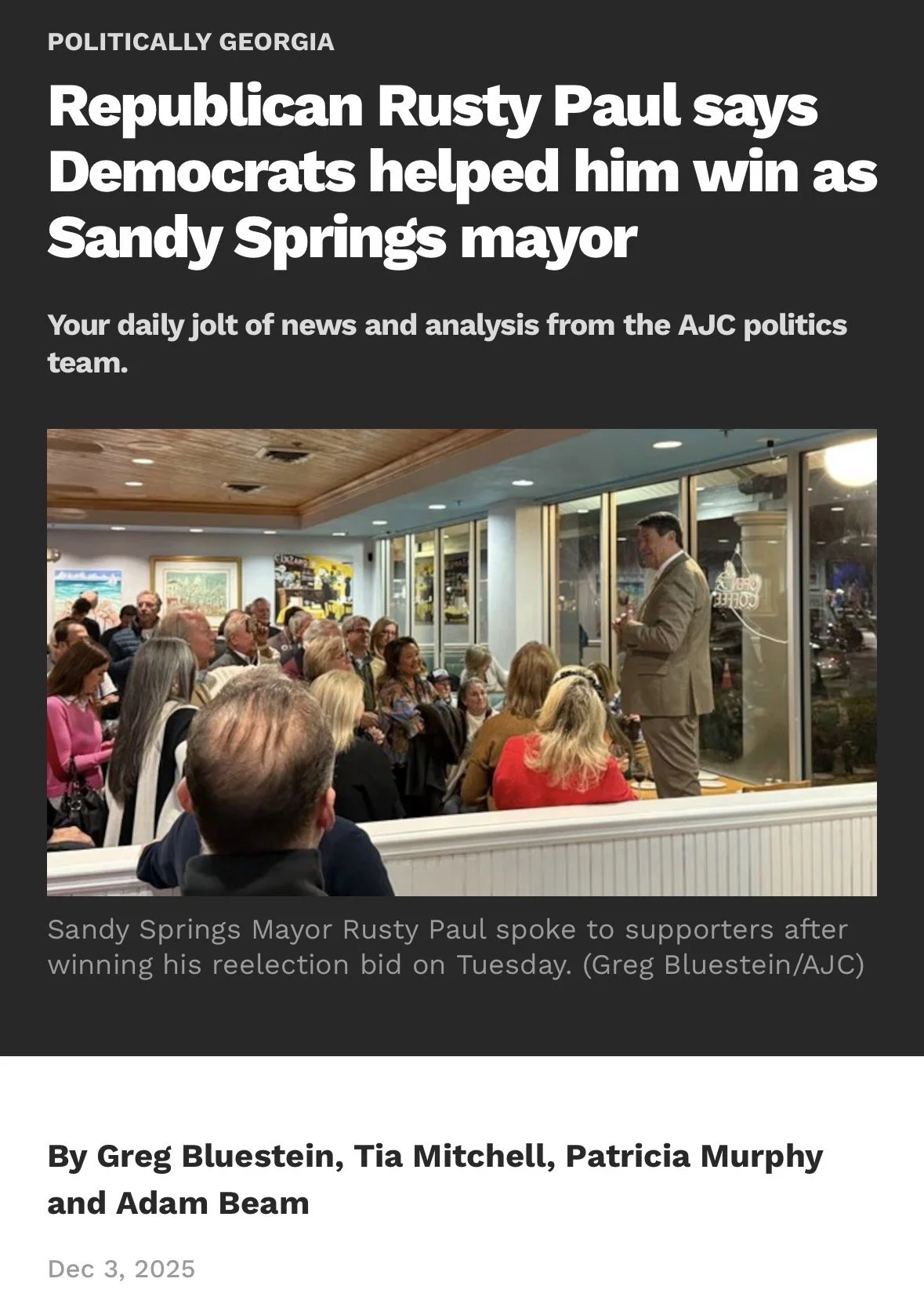
What the AJC Got Wrong About the 2025 Sandy Springs Runoff
The 2025 Sandy Springs mayoral runoff was not a rejection of progressive ideas. It was shaped by a compressed SB 202 runoff timeline, limited early voting before Thanksgiving, decades of incumbency advantage, low voter turnout, and media narratives that failed to fully interrogate facts, timelines, and context.
Progress is always validation.
I believe deeply in the role of journalism in a democracy. A free press matters. Accountability matters. Precision matters.
That’s why it’s important to address what Greg Bluestein and The Atlanta Journal-Constitution got wrong in their coverage of the 2025 Sandy Springs mayoral runoff — not out of grievance, but out of respect for the public record and for voters who deserve an accurate telling of what actually happened.
Numbers Matter. Context Matters.
During runoff coverage, the AJC published a quote from Georgia GOP Chair Josh McKoon stating that Mayor Rusty Paul won “over 70% of the vote.” He did not. The final tally was 68%.
You can absolutely report a quote. But when a factual inaccuracy is left unchallenged, it becomes part of a misleading narrative. Journalism is not stenography. Numbers matter. Precision matters. Context matters. Before I ran the first time in 2021, Republican’s won over 80-percent of the vote. That hasn’t happened in the last two election cycles.
When Timelines Are Ignored, Harm Follows
This was not an isolated issue.
Earlier reporting allowed Rep. Esther Panitch to frame her endorsement of Mayor Paul as a response to Gabriel Sanchez’s endorsement of my campaign — even though the timeline clearly shows her endorsement came first.
That wasn’t spin. It was factually incorrect.
Because it went unchallenged, that misrepresentation became the foundation for falsely painting me as antisemitic — a charge that Mayor Paul’s campaign later weaponized and that ultimately led to death threats directed at me and members of my team.
Unchecked timelines don’t just distort narratives. They can cause real harm.
This Was Not an Ideological Rejection
Throughout the race, half-truths, selectively framed anecdotes, and unchallenged quotes shaped the broader story more than verifiable data.
The result was a misleading impression: that this election represented a partisan repudiation of progressive ideas.
The data tells a different story.
The central dynamic of this runoff was generational, not ideological.
Democrats who supported Mayor Paul were overwhelmingly over the age of 60. Younger and middle-aged Democrats broadly supported my campaign. That matters — especially in a city undergoing rapid demographic and generational change.
Incumbency Is Not Momentum
Accuracy also requires honesty about Mayor Paul’s standing.
He is a fourth-term incumbent who has held elected office in Georgia since 1977.
A wide margin under those circumstances does not represent fresh political momentum. It reflects:
decades of incumbency
deep name recognition
institutional familiarity
comfort with the status quo
It is also impossible to separate those totals from the racist mailer that circulated during the runoff and the false insinuations that I was antisemitic — both of which undeniably influenced voter sentiment.
Voters Chose Change Before the Runoff
Sandy Springs is changing — and voters demonstrated that clearly.
Before the runoff, voters had two other establishment-aligned candidates to choose from. They did not select them. Instead, they advanced a different kind of candidate.
That alone disproves the idea that the electorate was simply seeking “more of the same.” Among Democrats, independents, and families, there was a clear appetite for something different.
Turnout Was Structurally Suppressed
Context matters most when assessing turnout.
Early voting for the runoff lasted only four days and occurred immediately before Thanksgiving — a timing that disproportionately suppresses participation among younger voters, working families, renters, and multicultural communities.
Before SB 202, Georgia’s runoff system looked very different:
Runoffs occurred nine weeks after the general election
Early voting lasted two to three weeks
Campaigns had time to engage younger, working-class, and diverse voters
SB 202 compressed everything:
a four-week runoff period
minimum early voting days
a pre-holiday voting window
The structural advantage shifted decisively toward older, habitual voters while dampening participation from emerging coalitions.
Low Turnout Is Not a Mandate
Fewer than 15,000 of the 66,000 registered voters in Sandy Springs participated in this runoff.
That is not a citywide referendum on ideology.
It is the predictable outcome of:
a compressed timeline
limited early voting
a pre-holiday election window
decades of incumbency advantage
With less than a quarter of registered voters participating, no one should treat this result as a sweeping endorsement of one agenda or a rejection of another.
Labels Without Balance Are Not Journalism
Finally, narrative fairness matters.
Repeatedly amplifying Georgia GOP dog whistles labeling me as “radical” — without factual balance or scrutiny — is reckless.
My campaign platform focused on:
housing affordability
community safety
small business growth
ethics and transparency
youth opportunity
None of that is radical. Nothing in my record as a journalist, public servant, or community leader reflects extremism.
Printing a label simply because it appears inside a quote does not place it above fact-checking.
Journalism requires more than repeating rhetoric. It requires testing rhetoric against reality.
The Story Deserved More Rigor
Telling this story as a sweeping ideological rejection — instead of what it actually was — a compressed holiday runoff shaped by incumbency, generational divides, low turnout, racially charged messaging, and partisan framing — is incomplete and misleading.
I am not asking for favorable coverage.
I am asking for accurate journalism that:
challenges quotes
checks timelines
clarifies numbers
interrogates labels
distinguishes fact from political spin
That is the job.
Sandy Springs is changing — demographically, generationally, and politically. A more honest and nuanced accounting of the 2025 Sandy Springs mayoral runoff election would reflect that reality.
Why This Matters for Sandy Springs Voters
This election analysis is not just about media accountability. It is about how local journalism, Georgia runoff election laws, and voter access shape outcomes in fast-changing cities like Sandy Springs. As debates continue around SB 202, municipal elections in Georgia, and low-turnout runoff races, accuracy and context are essential for voters trying to understand what actually happened — and what comes next for Sandy Springs.
Frequently Asked Questions About the 2025 Sandy Springs Runoff
Was the 2025 Sandy Springs mayoral runoff a rejection of progressive politics?
No. The data shows the runoff reflected generational divides, incumbency advantage, and turnout suppression, not an ideological repudiation. Younger and middle-aged voters broadly supported Dontaye Carter’s platform on affordability, transparency, and community safety.
How did SB 202 affect the Sandy Springs runoff election?
SB 202 shortened Georgia runoff elections from nine weeks to four, reduced early voting windows, and placed the runoff immediately before Thanksgiving. These changes disproportionately suppressed turnout among younger voters, renters, and working families in Sandy Springs.
How many voters participated in the Sandy Springs runoff?
Fewer than 15,000 of approximately 66,000 registered voters participated. With less than a quarter of eligible voters casting ballots, the runoff result cannot be considered a broad mandate on ideology or policy direction.
Why does media accuracy matter in local elections?
Local journalism shapes how voters understand outcomes. Unchallenged quotes, inaccurate timelines, and imprecise numbers can distort public perception and unfairly define candidates, coalitions, and communities.
What issues defined Dontaye Carter’s campaign for mayor?
The Dontaye for Mayor campaign centered on housing affordability, ethical governance, community safety, small business growth, youth opportunity, transparency, and preparing Sandy Springs for its next generation.
This post is part of an ongoing effort by Dontaye Carter to document the structural, demographic, and media dynamics shaping local elections in Sandy Springs and across Georgia.
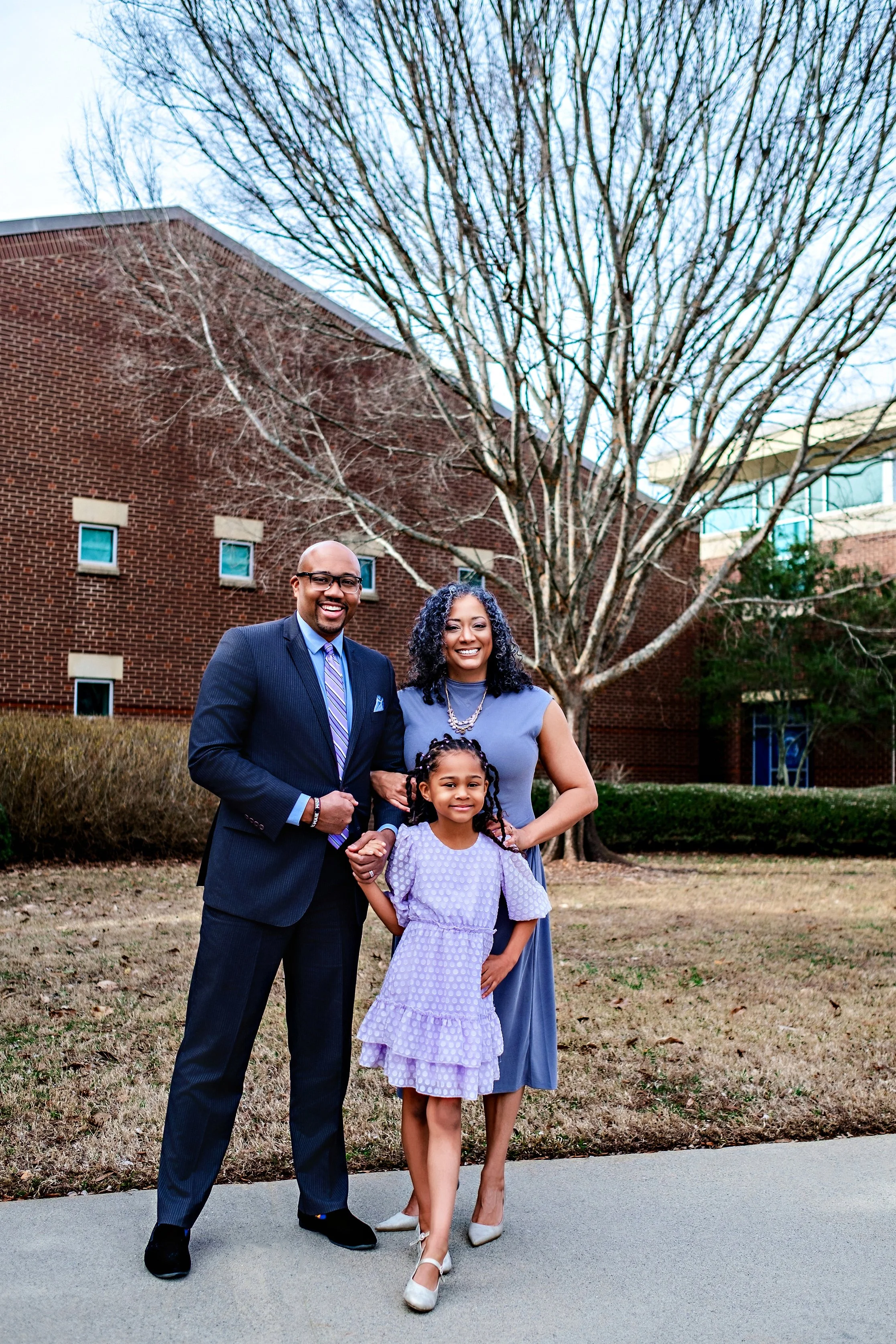
Ten Days Later: What This Election Taught Us — And Where We Go From Here
Ten days after the runoff, one truth stands firm: what we built together was bigger than a single election. We expanded who participates in local politics, elevated the real issues families face every day, and proved that community movements don’t vanish when the votes are counted.
Ten days have passed since the runoff, and I’ve had the space to process not just the results, but the journey that brought us here. Time has a way of sharpening what matters, and this moment is no different.
On Election Night, I said I was proud of the movement we built together. Ten days later, that pride has only deepened.
We activated new voters who had never participated in a local election.
We sparked conversations about affordability, mobility, housing, transparency, and dignity that too many families felt but had never seen reflected in city leadership.
We brought young voters, renters, working families, and new residents into a political process that had long moved without them.
Those weren’t campaign talking points — they were real shifts powered by real people.
To everyone who gave their time, energy, encouragement, donations, and belief: thank you. Your commitment changed what was possible in Sandy Springs. You helped expand who sees themselves in local government. And you reminded this city that community movements don’t disappear because of a single election result.
The night of the runoff, I reached out to Mayor Rusty Paul to congratulate him on his victory. I meant what I told him then and still mean it now: I look forward to bringing the ideas and concerns lifted up during this campaign into the broader conversation about our city’s future. Elections end. The work of building a better Sandy Springs does not.
These past ten days have reinforced something else:
This campaign wasn’t about me — it was about us.
It was about what happens when everyday people decide they deserve a voice in shaping their community.
I’m still committed to that work. I’m still present in our schools, our neighborhoods, and our conversations about the future. I’m still mentoring our kids, advocating for families, and showing up where community happens — not because of politics, but because that’s who I am and who we are.
Ten days later, the story hasn’t closed. It’s evolving.
I hope you’ll stay engaged, stay hopeful, and keep raising your voice.
Sandy Springs is worth the effort, the vision, and the fight.
And I’m still here — ready for the next chapter.